Shimane · Izumo, TaishaNo.422★★Open in map →
Izumo Soba
Buckwheat milled with the husk still on gives Izumo soba a dark noodle and a strong smell. It is eaten cold in stacked lacquer boxes or hot in its own cooking water, and Shinmon-dori is where both sit on one street.
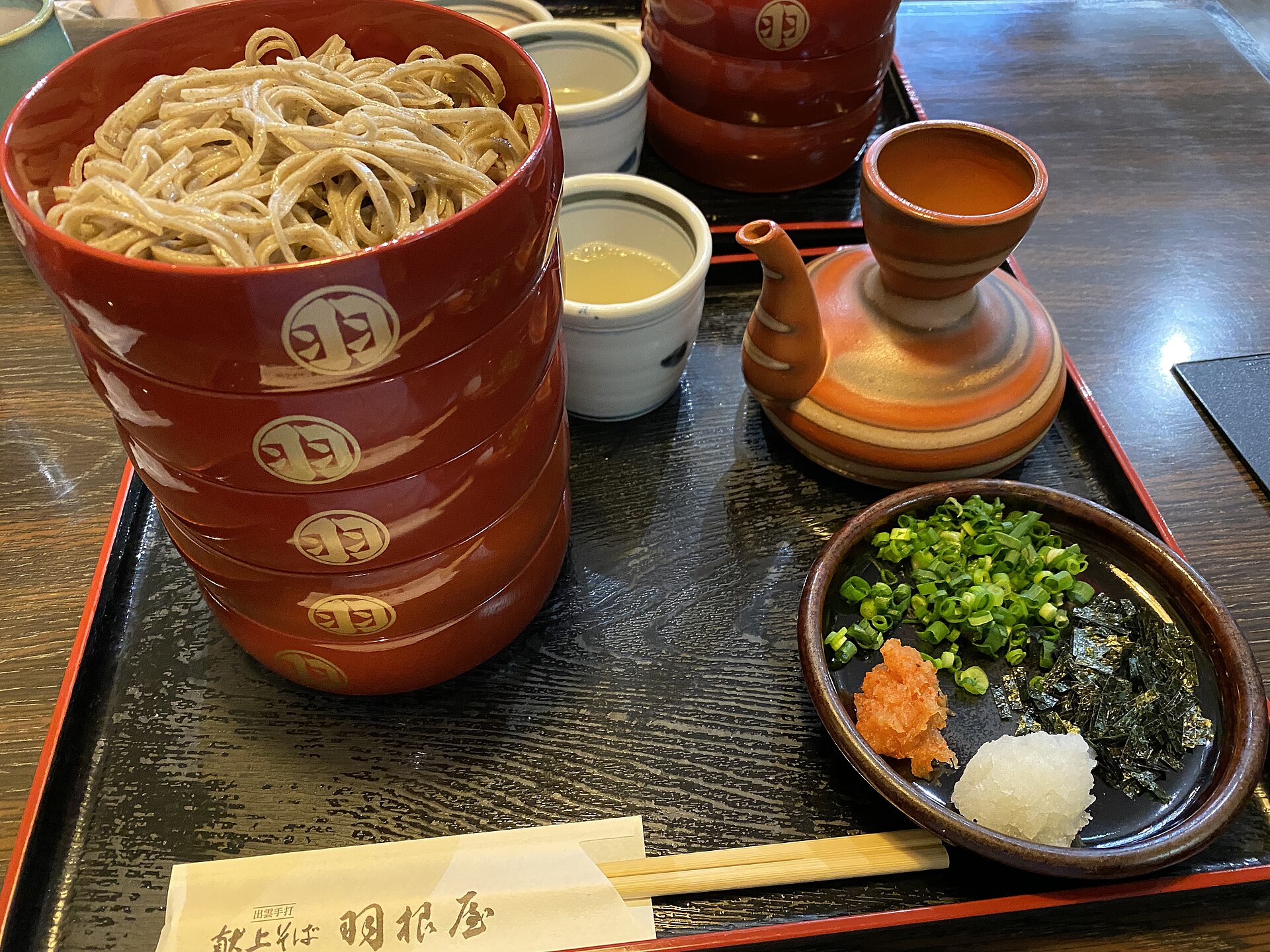
Izumo soba is milled whole. The buckwheat goes into the stone mill with its husk still on, so the flour is dark and the noodle comes out grey-brown, coarse at the edge and strong in the nose. It is eaten two ways, and neither of them dips. Warigo is cold, served in a stack of round lacquer boxes: you pour the broth straight onto the top box, eat it, then tip what is left into the next box down. Kamaage is hot, ladled out of the pot with its own cloudy cooking water and never rinsed, so the broth goes in to taste. Shinmon-dori is where both are easiest to find on one walk.
Why it stays quiet
This is the front door of one of Japan's best-known shrines, so the street is never empty. Its own logic is different from the shrine's, though. The shops face the walk rather than the gate, and the two ways of eating the noodle are a local argument rather than a tourist menu — locals order by which one the weather calls for. Arrive for the noodle and the approach reads as a street with a shrine at the end of it, not a queue.
Background & history
The noodle is said to have come over the mountains with a lord. When Matsudaira Naomasa was transferred from Matsumoto in Shinano to the Matsue domain, soba makers travelled with him, and the inland valleys of Izumo — cold, thin-soiled and already good buckwheat country — took to the craft. Pilgrims then ate it from stalls set up outside the shrines at festival time, and the unrinsed kamaage bowl belongs to those stalls, where rinsing noodles was not practical. February 11, the day that transfer was ordered, is now registered as Izumo Soba Day.
What to look for — in walking order
- Izumo-taisha-mae Station
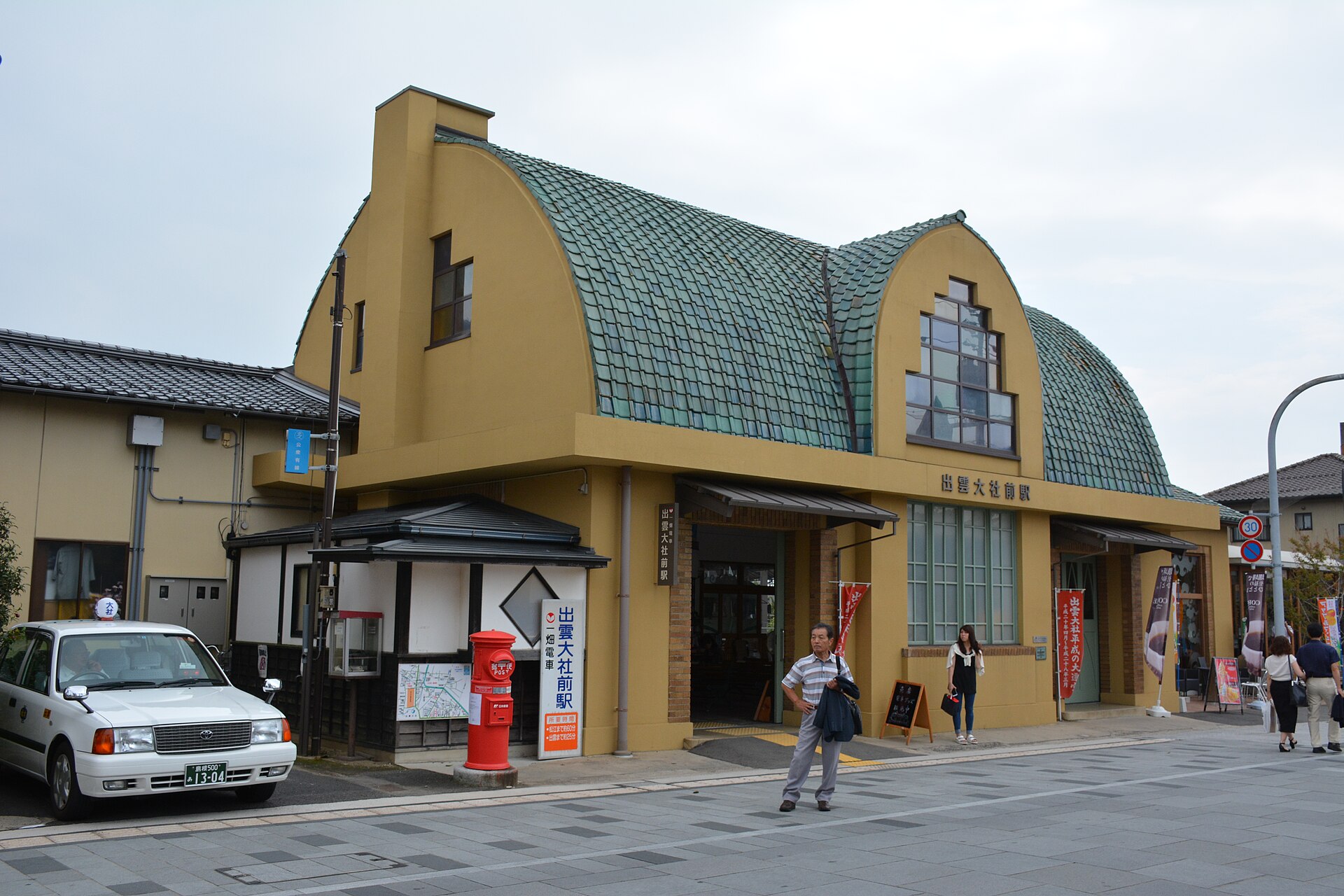
- the Taisha Line terminus, a Western-styled hall with stained-glass-like windows opening straight onto the approach
- Uka-bashi great torii
- the first torii, standing at the river end of the approach and listed as a registered tangible cultural property
- Shinmon-dori tourist information centre
- the street's public information office, where the shrine's guided walks start
- Goen Yokocho
- a short lane of souvenir stalls at the shrine end of the street
- Seidamari
- the second torii, where the approach ends and the shrine grounds begin
How to enjoy it
Order cold warigo if you want to taste the flour: the broth goes onto the noodles, and the leftover liquid is tipped down the stack from box to box, so the last box tastes different from the first. Order hot kamaage if the wind is up — it arrives unrinsed in its own cooking water, cloudy and thick, and you thin it with the same broth. Eating one of each is the honest way to settle which you prefer, and the street is short enough to do it in two sittings.
How to actually get there
- Okayama or Matsue → Izumo-shi Station (JR).
- Change to the Ichibata Electric Railway at Dentetsu-Izumoshi.
- Change again at Kawato onto the Taisha Line, and ride to the terminus at Izumo-taisha-mae.
- Walk Shinmon-dori: south first to the river torii, then north to Seidamari and the shrine.
- Ichibata Electric Railway from Izumo-shi
- Izumo-shi Station (JR) → Dentetsu-Izumoshi, the Ichibata company's own terminal → change at Kawato onto the Taisha Line → Izumo-taisha-mae, the end of the line, about 25 minutes in all. The station stands on Shinmon-dori itself, so the street begins where you step out.
- Return from Izumo-taisha-mae
- Take the Taisha Line back to Kawato and change there for Izumo-shi. This is a small private railway and the evening service thins out early, so check the last departure on the platform board before you sit down to eat. The Ichibata bus back to Izumo-shi Station is the alternative if the train has gone.
Before you go
- Cash
- The street itself and the tourist information centre on it are free. Warigo is priced by how many boxes you order, so the bill rises with the stack rather than with the menu; extra boxes are added one at a time. Small shops on an approach are not all card-ready, so keep some cash for the noodle and the souvenir stalls.
- Closing days
- Most of the street is daytime business and it quietens earlier than a city centre. The heaviest crowd comes in the tenth lunar month, when the Kamiari festival brings the country's deities — and the country's pilgrims — to the shrine and the approach fills. This is Sea-of-Japan weather in winter: the approach is open and the wind comes straight up it.
- Another way
- From JR Izumo-shi Station the Ichibata bus on the Hinomisaki line runs to the shrine, setting down at Seimon-mae by the south side of the gate or at the Izumo Taisha bus terminal one stop further on. It is the simpler option with luggage, since it needs no change.
- After you get off
- The Taisha Line terminus opens straight onto Shinmon-dori. Turn north for the tourist information centre, the souvenir lane and the torii at Seidamari where the shrine grounds begin; turn south for the first torii down by the river. Nothing on the street is more than a few minutes from the platform.