Wakayama · MinabeNo.428★★Open in map →
Kishu Nanko Plums
A free town museum on the roadside in Minabe, Wakayama, given over to the plum that this town grows more of than anywhere in Japan. Three floors cover the local past, the fruit itself, and a shop selling the umeboshi.
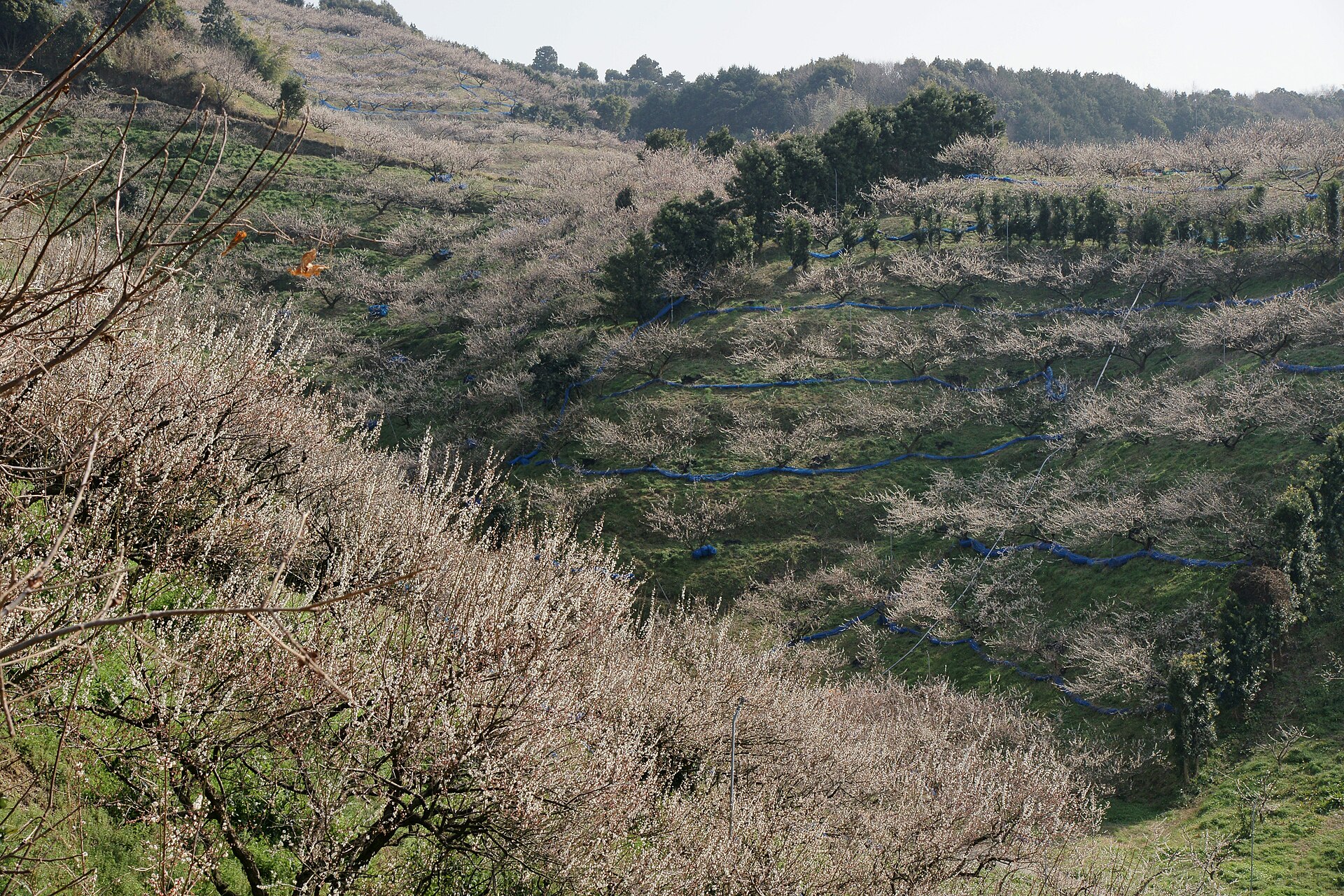
Minabe sits on the Kii peninsula, on ground too steep and too stony for ordinary farming. Growers there answered the terrain with an arrangement rather than a technique: coppice woodland left standing on the upper slopes, plum orchards planted below it, and beehives worked through the blossom so the fruit sets. The woodland holds the thin soil and feeds the charcoal kilns the region is also known for. Nanko-ume, the variety bred in this town, has thick soft flesh and a small stone, and it is the plum most Japanese umeboshi are made from.
Why it stays quiet
This is a working farm district rather than a sightseeing town, so the plum here is explained rather than staged. The town's own calendar decides the visit: blossom in late winter, harvest in early summer, and a free museum that stays open through the rest of the year.
Background & history
Plums have been grown on these slopes for some four hundred years, on terrain that suits little else. What developed was a system: woodland kept on the upper ground to hold the soil and supply the charcoal kilns, orchards on the slopes below, and bees carried through the blossom. In 2015 the United Nations recognised that arrangement, known as the Minabe-Tanabe Ume System, as a Globally Important Agricultural Heritage System. The museum's second floor is where the pieces are set out side by side.
What to look for — in walking order
- First floor, history gallery
- the district's farming past, with six bronze bells from the Yayoi period and a diorama of the charcoal trade
- Second floor, plum gallery
- the main exhibition floor, from where the plum reached Japan to how the pickling actually works
- The Nanbu Bairin panorama
- a large model of the town's plum grove, kept in bloom indoors all year
- The old umeboshi
- a pickled plum roughly 150 years old, displayed as an object rather than a photograph
- Nanbu Bairin
- the grove itself, out in the town, open for a few weeks while the blossom is out
How to enjoy it
The museum keeps 9:00 to 17:00, with the exhibition floors admitting visitors until 16:30, and there is nothing to pay. Late winter is the season the town is built around: the grove opens while the blossom is out and the slopes turn white, and that is when the panorama upstairs stops being a substitute. Any other month the top floor still earns the stop, because that is where the town's umeboshi is actually sold.
How to actually get there
- Shin-Osaka or Tennoji → Minabe Station (JR Kisei Line limited express; not every service calls here).
- Minabe Station → the museum (about 2.6 km inland; roughly 30 min on foot, or by taxi).
- Work up through the three floors, ending at the shop on top.
- In late winter, carry on to the town's plum grove while the blossom is out.
- JR Kisei Line to Minabe Station
- Limited express trains on the JR Kisei Line call at Minabe on the run down the coast from Shin-Osaka and Tennoji. From the station the museum is about 2.6 km inland, roughly thirty minutes on foot or a few minutes by taxi from the rank outside. Not every limited express stops at Minabe, so check the service before boarding.
- Return from Minabe Station
- Walk or take a taxi back to Minabe Station for northbound trains toward Wakayama and Osaka, or southbound for Kii-Tanabe and Shirahama. Because some limited expresses run through without calling here, fix your return service before you leave the station.
Before you go
- Cash
- Admission to the museum is free. The shop on the top floor sells the town's umeboshi and plum products, and payment methods at a small roadside station are worth confirming rather than assuming, so carry cash as well as a card.
- Closing days
- The museum closes on Tuesdays, taking the following day instead when a Tuesday falls on a public holiday, and again at the end of December. February is the exception and it opens every day through the blossom month. Individual closure dates are posted on the town's own site.
- Another way
- By car the museum doubles as a roadside station on Route 424, just inland of the Minabe interchange on the Hanwa Expressway, which is how most visitors arrive.
- After you get off
- From Minabe Station the museum lies about 2.6 km inland, up the river valley. It is around thirty minutes on foot, or a few minutes by taxi from the rank outside the station.